
Healthcare delivery is being radically changed. Over the last decade, telemedicine has evolved from an esoteric healthcare service that is mainly utilized to cover rural or underserved locations to a fundamental part of the modern digital healthcare infrastructure. Hospitals, imaging centers, outpatient clinics and specialist networks are now using remote consultation platforms for the diagnosis, treatment decision coordination and continued care of hospitalized patients without the need for the physician and patient to be in the same physical location.
At the core of this change is diagnostic imaging. Medical imaging is really important when doctors are trying to figure out what is going on with a patient in fields like radiology, cardiology, oncology orthopedics and emergency medicine. Doctors always look at medical imaging studies, like CT scans, MRI exams, X-rays, mammograms and ultrasound images to find out if someone has a disease to see how bad an injury is and to plan the way to treat the patient.
In the past when doctors wanted to look at medical imaging studies they had to use a system called Picture Archiving and Communication Systems that was usually installed in hospitals or places where medical imaging was done.These systems were based on local servers, dedicated workstations and internal hospital networks. While this is effective for a centralized healthcare environment, this infrastructure has its limitations when clinicians need to access imaging studies remotely.
Cloud-based PACS platform helps to overcome these challenges by providing a secure and web-based access to diagnostic imaging data from anywhere. By taking advantage of the benefits of cloud infrastructure, healthcare organizations can not only store and manage medical images efficiently but also distribute them across various regions using internet-based platforms that facilitate telemedicine, teleradiology and remote diagnostic workflows.
As telemedicine continues to grow worldwide, cloud PACS has become a basic technological tool for medical providers to integrate the various stages of grasping with each other regardless of distance, leaping forward in the diagnosis process and better access to specialized medical expertise by patients.
• Cloud-based Pacs Allows Remote Access To Diagnostic Imaging Studies Using Web-based Platforms.
• Telemedicine Environments Require A Lot Of Cloud Imaging Infrastructure To Enable Distributed Clinical Workflows.
• Remote Diagnostics Enables Radiologists And Specialists To Interpret Medical Images, No Matter Geographical Location.
• Cloud Pacs Removes Many Of The Limitations That Are Experienced With Traditional On-premise Imaging Systems.
• Modern Healthcare Networks Are Increasingly Relying On Cloud Imaging Solutions To Promote Collaboration, Scalability And Quicker Diagnostics Turnaround.
Telemedicine has really taken off as healthcare systems try to find ways to provide care that're better and more efficient. We need to make sure people can get the help they need no matter where they are. Now that we have internet connections, cloud computing and safe ways for doctors and patients to talk to each other doctors can help patients from a distance.
Healthcare providers are now using telemedicine for a wide array of healthcare services which include primary healthcare consultations, chronic disease management, specialist referrals, mental health therapy and post treatment consultation visits. The pandemic of coronavirus vastly promoted the use of telehealth platforms in the healthcare system; but even after the pandemic ended, the benefits of remote healthcare delivery ensured that telehealth continued to grow.
However, telemedicine becomes much more complicated with the use of diagnostic imaging. Radiology studies involve large datasets that have specific format requirements, visualization needs in high resolution, and precision in clinical interpretation. A single CT or MRI study is made up of hundreds or thousands of images. These images have to be looked at carefully.
The thing is, we need good computers and equipment to handle all of these medical images. We are talking about CT and MRI images. They have to be sent, stored and shown in a way that's safe and works well. If we do not have systems, for handling CT and MRI images it will be tough for telemedicine platforms to work properly with many diagnostic processes that use CT and MRI images.
Cloud PACS offers the digital healthcare cloud infrastructure that allows imaging information to become integrated with telemedicine environments.
Diagnostic imaging has become one of the greatest tools in modern medicine. Physicians often use radiological studies to confirm diagnosis, evaluate the severity of a disease and make treatment decisions.
In a traditional hospital setting, radiologists receive the imaging studies in reading rooms with dedicated workstations that are connected to local PACS servers. While this approach works well within the framework of centralized healthcare systems, it becomes limiting when clinicians need to work across multiple institutions or geographic regions.
Remote diagnostics involves clinicians being able to access imaging studies outside the hospital's parameters. A specialist hundreds, and possibly thousands of kilometers away will need to look at a patient's CT scan or MRI to give a second opinion or confirm the diagnosis.
Cloud PACS platforms make this distributed access model possible. Medical images reside in secure cloud infrastructure and can be viewed via the web-based DICOM viewers from practically anywhere. Instead of sharing imaging data across physical media like CDs or portable drives, clinicians just have to log into secure platforms to see imaging studies immediately.
This capability becomes especially valuable in medical situations that are time-sensitive, like stroke evaluation, trauma assessment and emergency consultation, because the ability to access imaging data quickly can mean a big difference in patient outcome.
A Picture Archiving and Communication System is a tool for medical images. This system is used to store images organize them find them when you need them and share them with others.The Picture Archiving and Communication System works closely with the DICOM medical imaging standard, which ensures that medical images are formatted correctly sent and can be understood by the people who need to see them.
Traditional Picture Archiving and Communication Systems are usually set up in hospitals. These systems need a lot of equipment like big servers to handle the images large storage spaces to hold all the images fast networks to move the images around and people to take care of the systems and make sure they are working correctly.
Cloud-based Picture Archiving and Communication Systems do things differently. They move all the equipment and work to a place, on the internet called the cloud, which is located in special buildings far away. Instead of using local servers to create storage, the imaging studies are saved to scalable cloud storage systems. Clinicians use these studies via secure Web applications that act as DICOM viewers.
Modern cloud-based PACS platforms usually contain a set of fundamental components:
• Dicom Image Storage Systems
• Metadata Indexing/study Management Tools
• Secured Image Transmission Protocol
• Dicom Viewing Applications Based On The Web
• Integration Interfaces For Ris, His And Ehr Systems
By taking advantage of the cloud infrastructure, healthcare organizations can grow imaging storage capacity, simplify maintenance of the system and to allow for distributed access to imaging studies.
For telemedicine environments to be useful, medical images need to flow through a digital cycle connecting imaging hardware to the cloud and to remote doctors. Cloud PACS platforms are the central point that makes this process possible.
A simplified workflow of a telemedicine imaging work process can be described as follows:
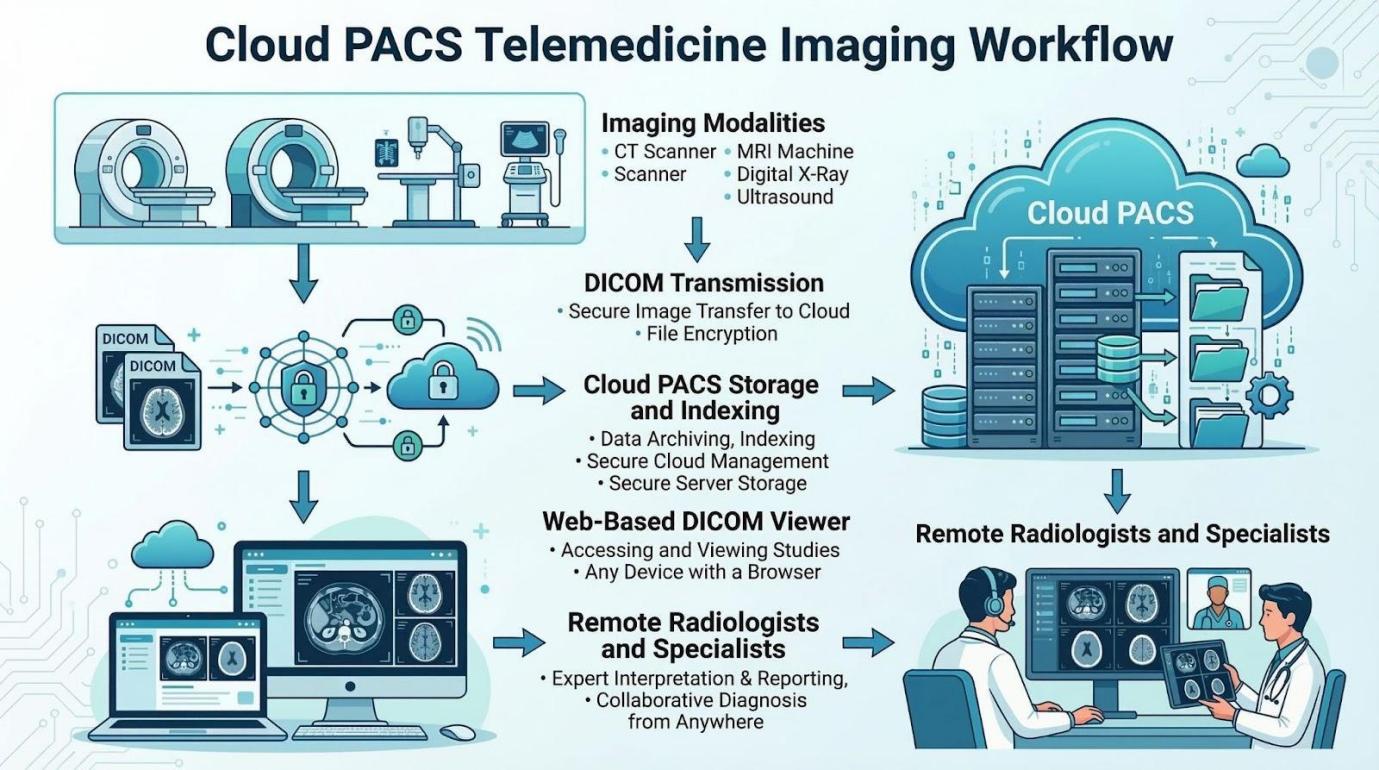
In this architecture, imaging modalities produce studies in the DICOM format. These studies are sent over secure networks to cloud PACS storage systems where the studies are archived and indexed.
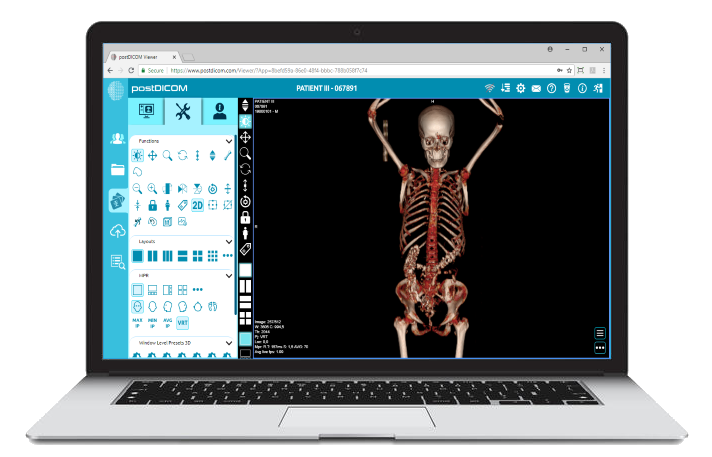
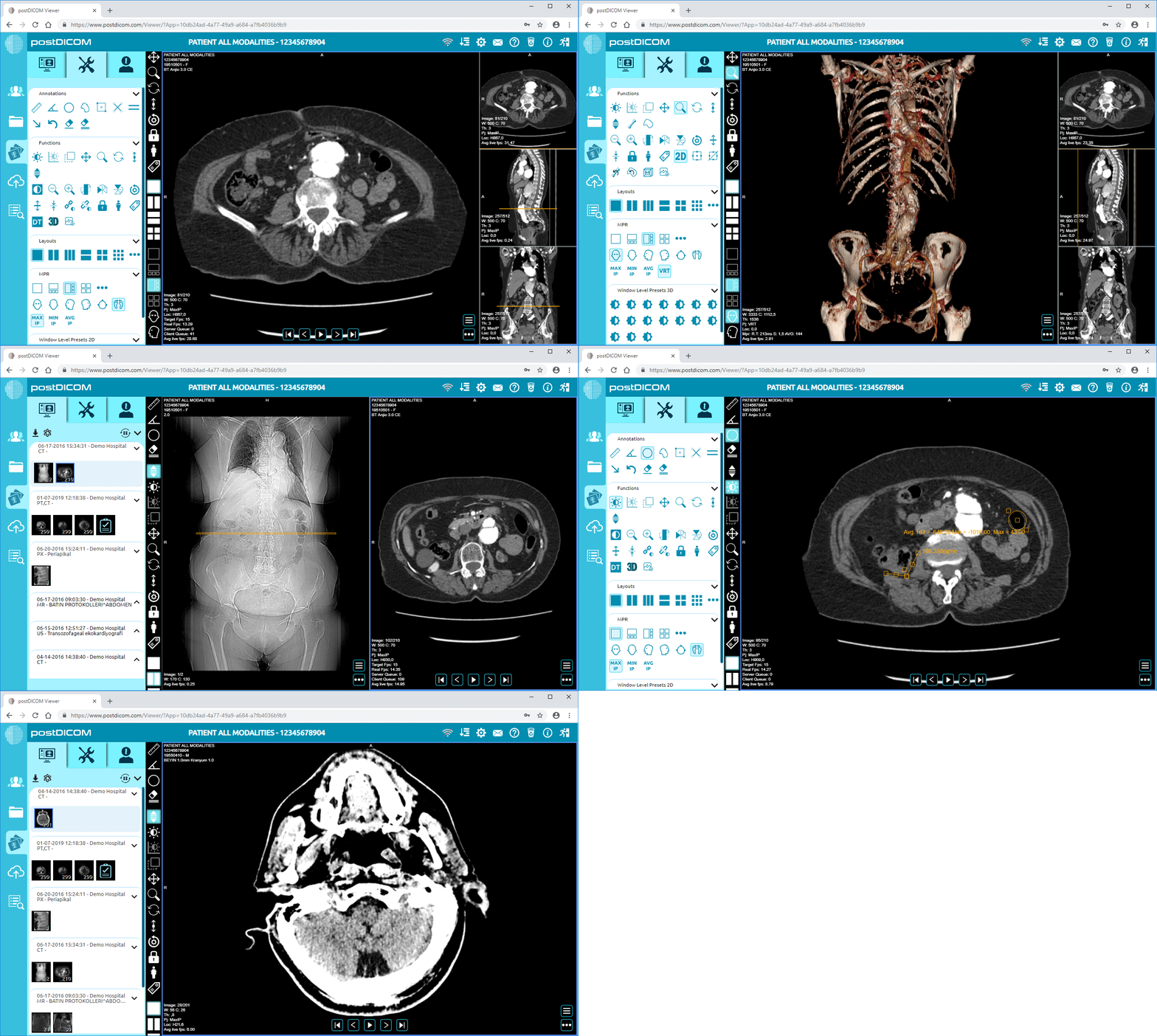
Clinicians are then able to retrieve the studies and view them using web-based DICOM viewer without the need for specialized workstation software. Because the system is implemented with the help of cloud infrastructure, multiple physicians can access the same imaging study at the same time from different places.
This distributed access model gives telemedicine platforms the ability to facilitate collaboration among hospitals, imaging centers and independent specialists while optimizing teleradiology workflows.
 - Presented by PostDICOM.jpg)
| Feature | Traditional PACS | Cloud-Based PACS |
| Remote Access | Requires VPN or local workstation | Accessible via web browser |
| Scalability | Limited by hardware capacity | Elastic cloud storage |
| System Maintenance | Managed by local IT teams | Managed by cloud provider |
| Telemedicine Integration | Complex and limited | Designed for distributed access |
| Collaboration | Restricted to local network | Multi-location collaboration |
This comparison is the reason why a professional cloud PACS solution is becoming the choice in telemedicine environments.
Cloud PACS allows the clinicians to view the imaging studies from virtually any location provided you have an internet connection. Radiologists can consult studies from workstations at home, consulting physicians can view studies during telemedicine sessions, and experts can work between institutions.
Cloud imaging infrastructure eliminates delays that come with transferring studies from one hospital or clinic to another. Physicians have access to the imaging data as soon as it is acquired, leading to reduced diagnostic turnaround times in the process and quicker patient care.
Modern healthcare is more dependent on multi-disciplinary care teams. Cloud PACS enables radiologists, surgeons, oncologists, and referring physicians to read imaging studies at the same time and collaborate on treatment decisions.
The volumes of medical imaging are still increasing as healthcare providers are more dependent on technologies for diagnostics. Cloud storage systems enable Healthcare organizations to scale up their imaging capacity without the need for buying new hardware or upgrading the local infrastructure.
Cloud PACS has many applications for telemedicine in various healthcare systems.
In rural healthcare settings, hospitals won't necessarily have access to a radiologist who works full time. Cloud imaging platform enables imaging studies to be transmitted immediately to radiologists sitting in urban medical centres who have the facility of resorting remote interpretation of the studies. This ensures the patients receive expert diagnostic evaluations no matter where they are.
Emergency departments also find cloud-enabled imaging systems useful. Trauma cases and stroke patients need to have immediate imaging interpretation. Cloud PACS enables specialists to access the CT scans or MRI studies on time and make treatment decisions quickly.
Healthcare networks that have multiple hospitals use cloud PACS platforms to share imaging studies between hospitals. Physicians have access to a patient's entire imaging history, even if the studies were obtained at different facilities.
Healthcare imaging systems have special and very strict regulatory requirements set to ensure patient data safety and privacy. Secure cloud imaging platform solutions are integrated with high security which protects the medical information and also enables to access remotely.
Some of the common security features are:
• Image Transmission In The Form Of End-to-end Encryption
• Role Based Access Controls Implementation Systems
• Multi-factor Authentication
• Comprehensive Audit Logging
• Compliance With Health Care Regulations Such As Hipaa And Gdpr
Many cloud providers invest heavily in their cybersecurity infrastructure and as a result often offer greater cybersecurity capabilities than traditional on-premise deployment methods.
 - Presented by PostDICOM.jpg)
The combining of cloud PACS with telemedicine platforms is only the start of more widespread change in medical imaging cloud infrastructure. Emerging technologies like artificial intelligence, advanced analytics, and interoperable healthcare data platforms are likely to further increase the capabilities of cloud imaging systems.
Artificial intelligence algorithms are increasingly being incorporated into PACS settings to help with image analysis, detecting anomalies, and optimizing workflows. These kinds of technologies can help radiologists interpret studies more efficiently and make fewer diagnostic mistakes.
Interoperability standards like HL7 and FHIR are also helping to improve connection between imaging systems and electronic health records. As healthcare data ecosystems become more interconnected, clinicians will gain access to their patients' imaging studies in conjunction with laboratory results and patient histories together with clinical notes in unified platforms.
Cloud PACS platforms are likely to be a central part of this evolving digital healthcare ecosystem.
Cloud PACS is a medical imaging system with the diagnostic images stored in the cloud system and the clinicians can access the images remotely by using secure web-based DICOM viewers.
PACS systems also store the imaging studies in a standardised DICOM format and enable physicians to retrieve and interpret the images using viewing software. Cloud PACS is an extension of this capability, allowing remote access via internet-based platforms.
Yes. Cloud PACS platforms enable remote access to imaging studies for radiologists from remote workstations and, therefore, transform radiology and the healthcare industry by facilitating teleradiology and telemedicine services.
Modern cloud-based PACS have encryption, access control systems and compliance mechanisms such as HIPAA and GDPR in place to secure patient data.
Cloud PACS facilitates the sharing of imaging studies between healthcare providers, providing quick diagnosis and better collaboration, and remote healthcare provision.
Yes. Most cloud PACS platforms support interoperability standards, like HL7 and FHIR, which enable integration with electronic health records (EHR) systems and radiology information systems (RIS).
DICOM (Digital Imaging and Communications in Medicine) is the international standard that is used to store and communicate medical images. Cloud PACS systems are equipped with DICOM technologies to ensure that the imaging studies of different modalities like CT, MRI and ultrasound can be stored, shared and interpreted across healthcare systems.
Remote radiology workflows usually demand stable broadband connections that are able to efficiently transmit large imaging datasets. Most modern adopters of cloud PACS systems have these systems optimized for streaming medical images and can perform effectively with standard hospital-grade internet connections.
|
Cloud PACS and Online DICOM ViewerUpload DICOM images and clinical documents to PostDICOM servers. Store, view, collaborate, and share your medical imaging files. |

